
Alaska Criminal History Records
Alaska criminal history records come from several state agencies, and knowing where to look makes the search much easier. The Alaska Department of Public Safety runs the main criminal records repository. From there you can request a name-based or fingerprint-based background check on any person. You can also search court cases through the Alaska Court System's free CourtView portal, look up registered sex offenders, check inmate status, and find arrest records from local law enforcement. This guide covers each of those sources and tells you what each one contains, what it costs, and how to submit a request.
Alaska Criminal History Overview
Alaska Criminal Records and Identification Bureau
The Alaska Department of Public Safety operates the Criminal Records and Identification Bureau, commonly called the R&I Bureau. This office is the central repository for Alaska criminal history. All arrests, charges, and dispositions reported by law enforcement agencies across the state flow into this system, known as APSIN. Under AS 12.62.160, any person may request criminal justice information from this repository. That is the statute that makes Alaska criminal history available to the general public, not just employers or government agencies.
There are two types of checks you can request. A name-based search costs $20 and searches the Alaska Public Safety Information Network by the person's full name and date of birth. The limitation is that name-based results may miss records filed under aliases or slightly different name spellings. A fingerprint-based check costs $35 and uses biometric identification to match records with certainty. The DPS recommends fingerprint checks when accuracy matters most. Fingerprints must be submitted on a standard FD-258 FBI fingerprint form. Cards submitted in other formats will be rejected.
Walk-in service is available at the main office. You can also submit requests by mail or through the online portal. Walk-in requests are processed the same day. Mail-in requests take about 10 business days. Results are delivered by mail or fax. The R&I Bureau does not send results by email.
Contact Information:
| Address | 5700 East Tudor Road, Anchorage, AK 99507 |
|---|---|
| Phone | (907) 269-5767 |
| Fax | (907) 269-5091 |
| dps.criminal.records@alaska.gov | |
| Hours | Monday through Friday, 8:00 AM to 4:30 PM |
| Name-Based Fee | $20 |
| Fingerprint Fee | $35 |
Lead-in text about the official DPS background check portal: Alaska Criminal History Background Check Portal.
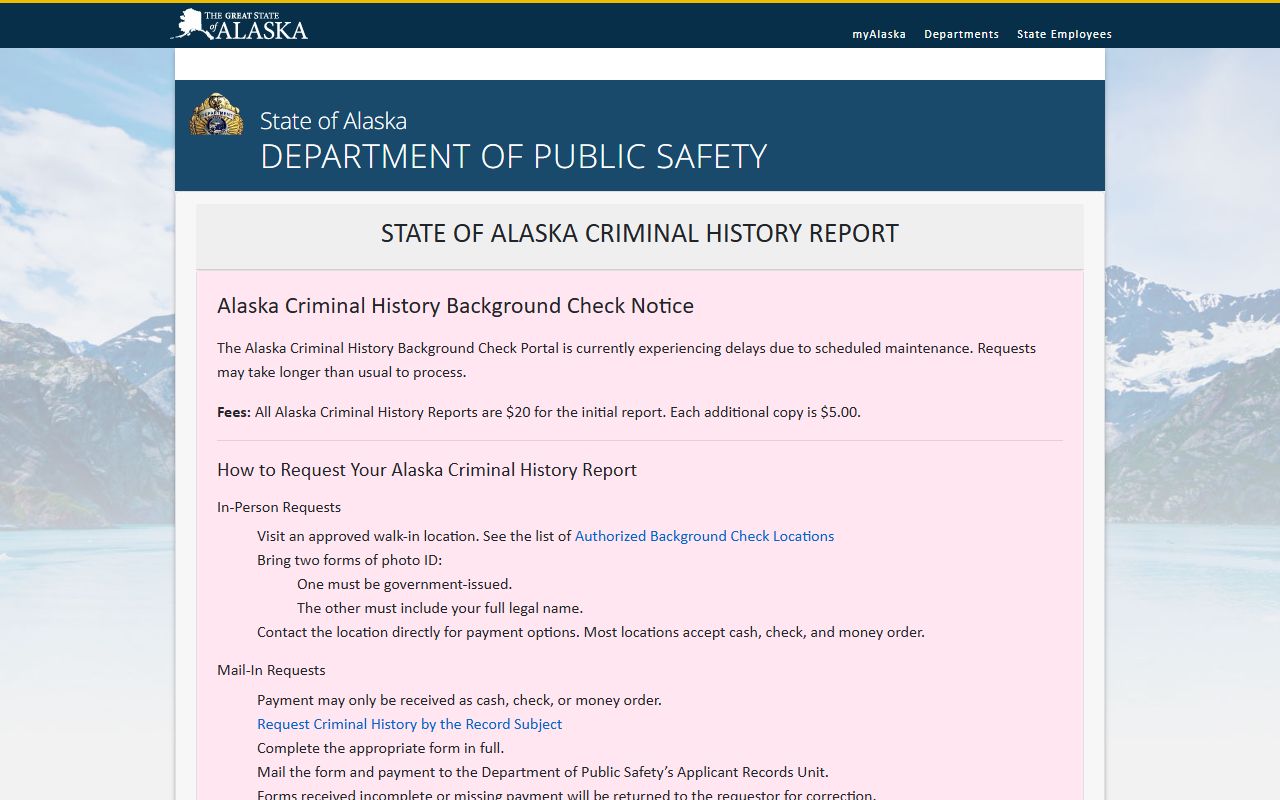
The online portal at backgroundcheck.dps.alaska.gov lets you start a name-based criminal history request by email verification. You enter your email, receive a secure link, then fill out the full form online. Keep in mind that results still come by USPS mail only, not by email, so allow time for delivery after your request is processed.
Note: Juvenile records and sealed or expunged records are not included in standard Alaska criminal history reports available through the R&I Bureau.
Alaska CourtView Criminal Case Search
CourtView is the Alaska Court System's free public case search tool. It covers trial court cases in Superior and District Courts across all 40 judicial locations in the state, plus appellate cases from the Supreme Court and Court of Appeals. You can search by party name, case number, or citation number. Results show the case type, filing date, charges, hearing dates, and current status. It is free to use and available online around the clock.
One thing to know: a CourtView search is not the same as a criminal history check. The disclaimer on the site says this clearly. Some records never appear on CourtView at all. Others are removed over time. Under state law, the Alaska Court System may not publish a criminal case on a publicly available website if 60 days have passed since an acquittal or dismissal. That means dismissed charges and not-guilty verdicts drop off the public search after two months. If you need a complete record including non-conviction data, you need a DPS background check, not a CourtView search.
Court case documents are not available online. If you want copies of filings, you have to go to the clerk's office in person or send a written request by mail. Public terminals at all courthouse locations give you free access to CourtView on site. Sealed cases and juvenile matters do not show in results.
The Alaska Court System is structured in four levels. Superior Court handles felonies and serious civil matters. District Court handles misdemeanors and smaller civil cases. The Court of Appeals reviews criminal convictions. The Supreme Court handles final appeals and also administers the court system. There are four judicial districts covering the whole state: First District (Southeast), Second District (North), Third District (Southcentral), and Fourth District (Interior).
View the Alaska CourtView case search portal to run a free search.
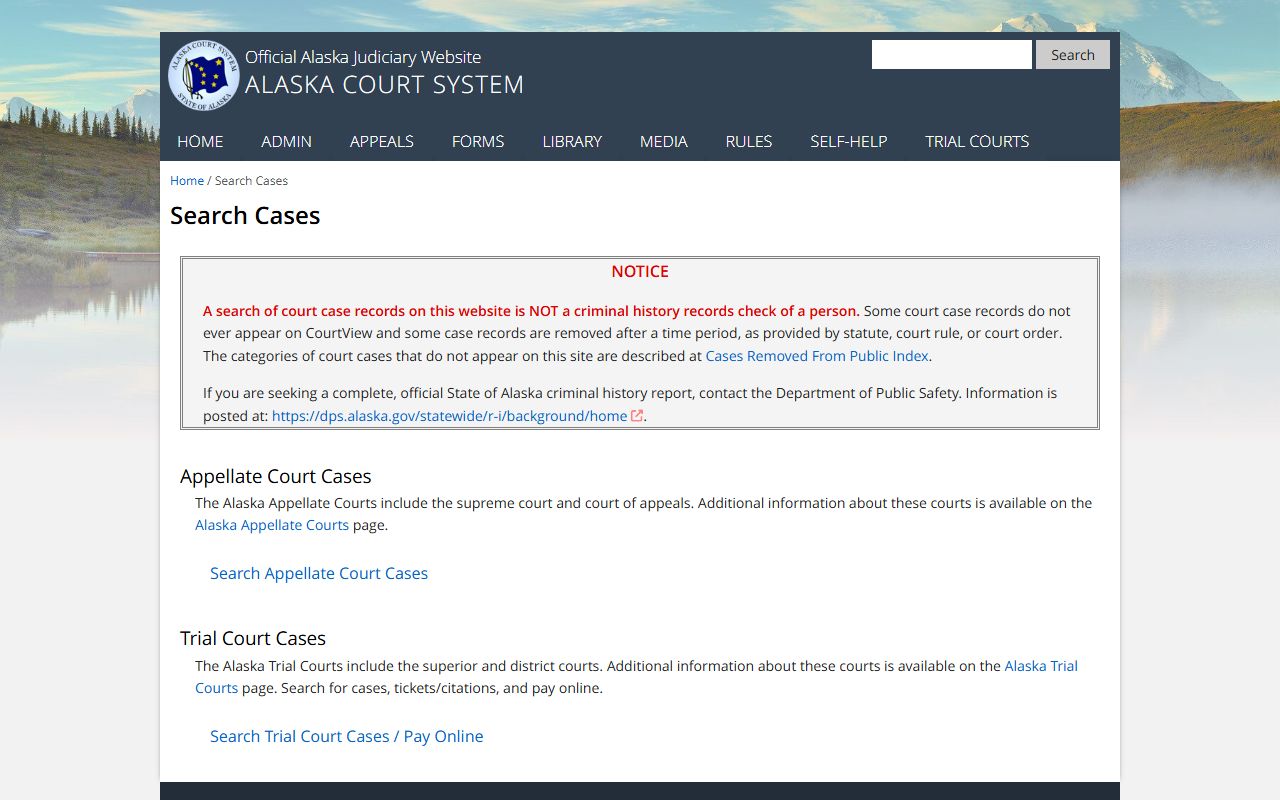
CourtView shows criminal case status and hearing dates across all Superior and District Courts in Alaska, making it a useful starting point when looking up Alaska criminal case records by name.
The main Alaska Court System website at courts.alaska.gov also has forms, court calendar tools, self-help resources, and directions for requesting copies of court records from clerk offices statewide.
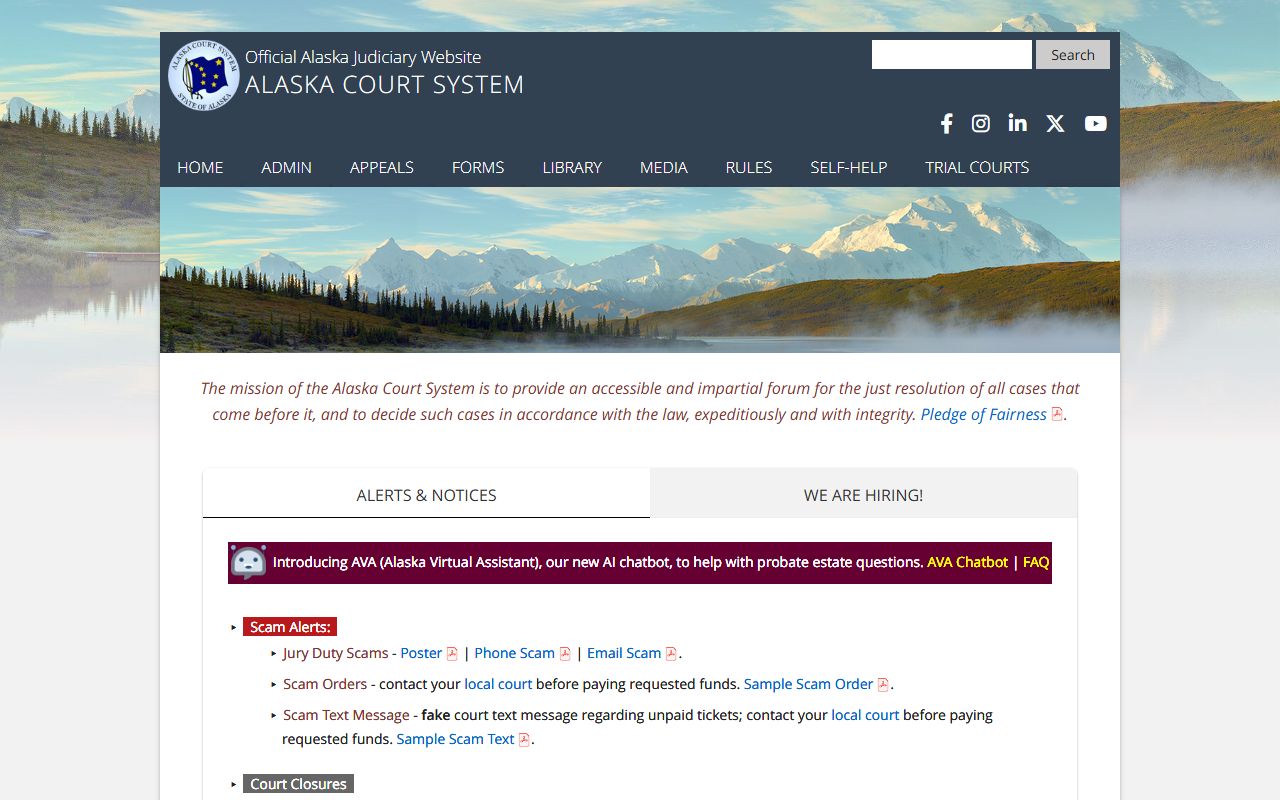
The Alaska Court System site provides courthouse locations, hours, eFiling tools, and access to forms for all court levels, including resources for people who are representing themselves in criminal or civil proceedings.
Important: A CourtView search does not replace a formal criminal background check. Dismissed cases are removed after 60 days under Alaska court rules, so CourtView does not show the full picture of a person's criminal history.
Online Background Check Portal
Alaska DPS runs an online self-service portal for name-based criminal history requests. To start, you go to the portal and enter your current email address. The system sends a secure link to that address within a short time. You click the link and fill out the full request form, which asks for your full legal name, date of birth, Social Security number, and Alaska driver's license or DMV-issued ID number. That last part is how the system verifies your identity before processing the request.
Online requests go through the same processing queue as mail-in requests and typically take 5 to 7 business days. The finished report goes out by USPS mail to the address you provide. There is no option for electronic delivery. This is a security measure to protect the information in the report. If you need extra copies, you must request them at the same time as your original. Each extra copy costs $5. Additional reports ordered later cost $20 each.
Third-party requests work a little differently. If you want to request a criminal history report on someone else, that person must sign a consent form. They also need to sign an Unsworn Falsification Statement at the bottom of the Subject Information form. Consent is valid for 90 days. Requests with missing forms or missing payment come back to you for correction before they are processed.
Note: The DPS background check FAQ at dps.alaska.gov/statewide/r-i/background/faq lists all walk-in locations statewide and explains the full range of request options available to Alaska residents.
Alaska Sex Offender and Child Kidnapper Registry
Alaska maintains a public sex offender and child kidnapper registry under AS 18.65.087. The Department of Public Safety manages the registry and keeps it current. As of the latest data, the registry holds 3,640 entries. You can search by name, address, zip code, city name, or registration status. The registry is free to use and shows each registrant's photograph, physical description, and conviction information. A mapping feature lets you see where registered offenders are located.
Registration rules in Alaska are strict. A convicted sex offender who is not incarcerated at the time of conviction must register by the next working day after the conviction. A person being released from an Alaska correctional facility must register within 30 days before release. Anyone who comes into Alaska from another state and is required to register elsewhere must register by the next working day after arriving. Most offenses carry a lifetime registration requirement. Certain tier I offenses may qualify for a reduction to a 15-year registration period after review. Failure to register is a felony offense.
In July 2024, House Bill 66 was signed into law. It added new reporting requirements for registered offenders, including passport numbers, professional licensing details, temporary lodging stays of seven days or more, and plans for international travel. Alaska Statute 12.63.100(6) defines who qualifies as a sex offender for registry purposes, covering both in-state convictions and out-of-state convictions requiring registration in the original jurisdiction.
Search the Alaska Sex Offender Registry to look up registered offenders by name or location.
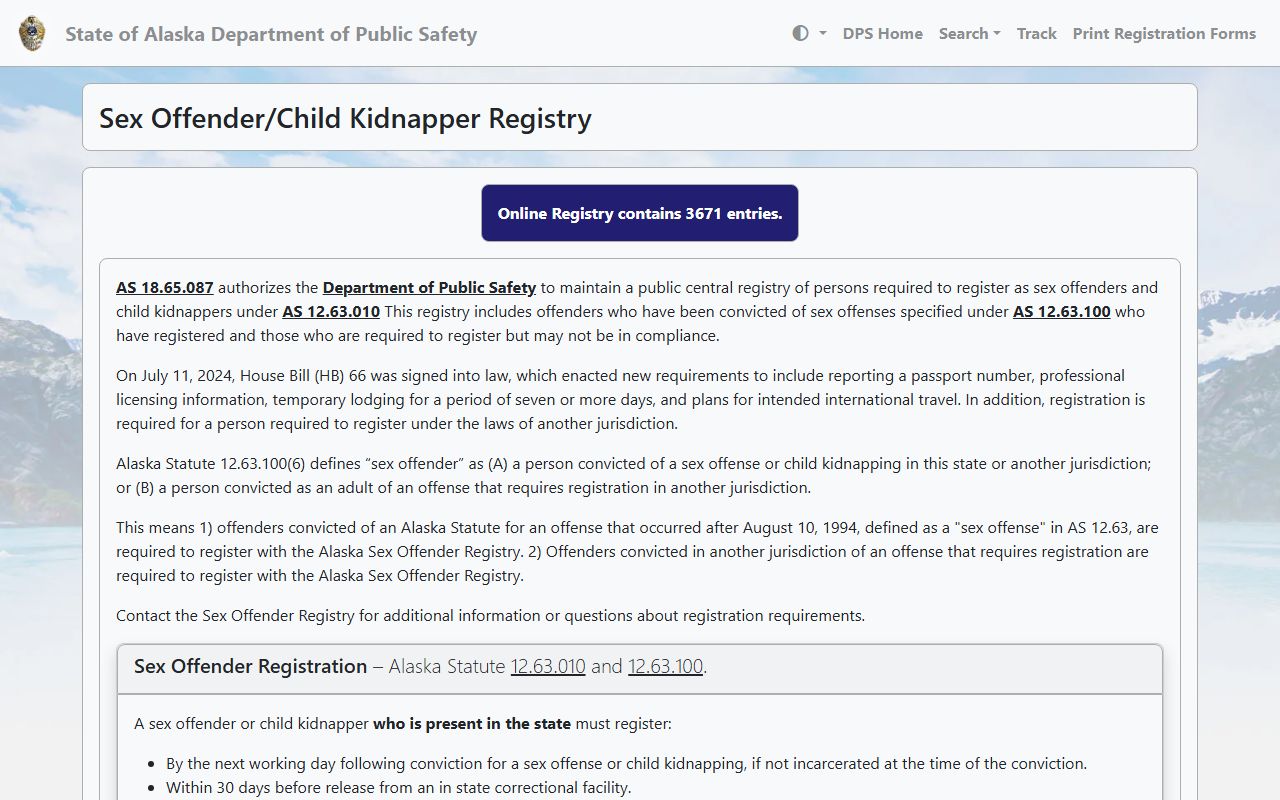
The registry updates daily and includes a non-compliant offender list for individuals who are required to register but may not be in current compliance with Alaska registration laws.
Alaska State Troopers and Active Warrants
The Alaska Department of Public Safety oversees the Alaska State Troopers, who provide law enforcement throughout most of the state's rural and unincorporated areas. The trooper organization is divided into four detachments. A Detachment covers the Anchorage area, Prince William Sound, and the Kenai Peninsula. B Detachment handles the Mat-Su Valley, Valdez, and Interior Alaska. C Detachment serves Southeast Alaska, including Juneau, Ketchikan, and Sitka. D Detachment covers Western Alaska, including Nome, Kotzebue, Bethel, and Barrow.
The DPS website lists daily dispatch information and maintains an active warrants database. Warrant records and arrest records from trooper posts are part of the broader Alaska criminal history system. The Alaska Bureau of Investigation handles major crimes statewide. If you have a tip about a wanted person or active warrant, you can contact the anonymous tip line at 907-269-5497.
In addition to criminal investigations, the troopers run the Bureau of Highway Patrol on designated roads and Wildlife Troopers for fish and game enforcement. The Village Public Safety Officer (VPSO) program extends basic law enforcement presence to smaller communities throughout rural Alaska where full-time trooper posts are not present.
Visit the Alaska Department of Public Safety website for contact information for trooper posts statewide, active warrant information, and daily dispatch logs.
Alaska DOC Inmate Search
The Alaska Department of Corrections operates 13 correctional facilities across the state. Spring Creek Correctional Center in Seward is the largest men's prison, a maximum-security facility with a capacity of 500 inmates. It opened in 1988. Hiland Mountain Correctional Center in Eagle River is the largest women's facility, housing up to 415 inmates at medium and close security levels. It opened in 1987. Other facilities include Anchorage Correctional Complex, Anvil Mountain Correctional Center, and Goose Creek Correctional Center.
Inmate searches use the VINE platform, which stands for Victim Information and Notification Everyday. You can search by inmate first and last name or by ID number. Partial name searches work too. Results include the person's name, gender, race, ID number, facility location, and custody status. Booking photos appear when available. The data updates nightly from DOC systems.
VINE also lets you register for free notifications. If an inmate you are tracking changes status, whether that is a transfer, release, or other update, you get an alert by phone, email, or TTY. This service is free and does not require you to explain why you want the notifications. Search current Alaska inmate records through the Alaska DOC inmate search tool.
The inmate search tool covers all 13 Alaska DOC facilities and includes probation and parole status, release date estimates, and facility contact information for each location.
Alaska Public Records Act
The Alaska Public Records Act, or APRA, gives the public the right to access government records. The statute runs from AS 40.25.100 through AS 40.25.295. Criminal history records are technically exempt from APRA under AS 12.62.160, which sets up its own access rules for that type of information. But APRA still applies to a wide range of related records, including police incident reports, court administrative records, jail logs, and other documents kept by public agencies.
Under APRA, you do not need a specific form to make a request. It just has to be in writing. You can submit by mail, email, fax, or in person. The agency has 10 working days to give you an initial response. That response may hand over the records, deny the request with a citation to a specific exemption, ask you for more information, estimate the cost, or notify you that more time is needed. The day your request arrives counts as day zero. The clock starts on day one.
Fees for copies are typically $0.25 to $0.50 per page for physical records. Search time may be charged if your request is for commercial purposes. If you disagree with a denial, you can appeal to the agency head. The appeal window is 60 working days from the date the denial was issued. If you win the appeal, attorney fees may be awarded. Each state agency and municipality in Alaska has a designated public records officer who handles these requests.
Exemptions under APRA include personnel files, medical records, ongoing investigation records, juvenile records, and trade secrets. Law enforcement exemptions are laid out separately in AS 40.25.120. Even when an exemption applies, the agency may be required to hand over the non-exempt parts of a record with the protected sections redacted.
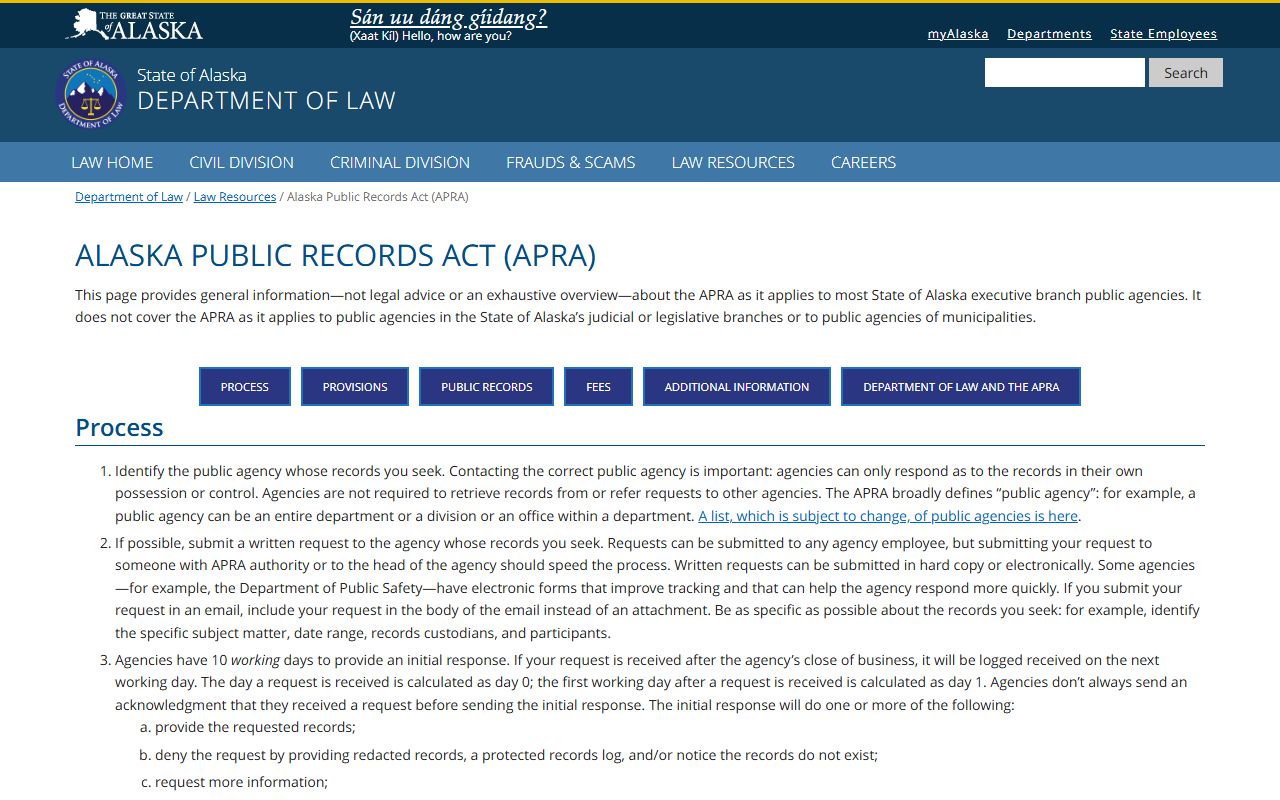
The Alaska Department of Law publishes the full APRA text and related guidance documents online. The page explains the process for submitting a records request and what to do if a request is denied.
Note: APRA requests for law enforcement records may face partial denials when active investigations are involved, with redacted copies of the remaining content still provided to the requester.
Alaska Criminal History Laws
Several Alaska statutes shape how criminal history records are collected, stored, and released. AS 12.62.110 establishes APSIN, the Alaska Public Safety Information Network. This is the central database for criminal justice information in the state. All criminal justice agencies, including courts, police departments, and correctional facilities, are required to report arrests and dispositions to APSIN within 30 days.
AS 12.62.160 is the key public access statute. It says any person can request criminal justice information. The law also specifies what cannot be released: nonconviction information is restricted, and certain correctional treatment information is not available to the public. AS 12.62.170 requires criminal justice agencies to correct records that contain errors. If information in your criminal history file is wrong, you have the right to challenge it and have it fixed or annotated.
Sealing and expungement are addressed under AS 12.62.180. Not all records qualify. Alaska's expungement process is more limited than some other states. Certain misdemeanor convictions may qualify for expungement after a waiting period and completion of any sentence. Sealed or expunged records do not appear in standard public searches or background check results.
AS 12.62.400 covers national criminal history record checks for employment, licensing, and other non-criminal justice purposes. This statute governs how fingerprint-based FBI checks work for things like professional licensing, foster care, and adoption approvals in Alaska. These checks run through the DPS but tap into the national FBI database rather than just the Alaska repository.
Title 12, Chapter 62 of the Alaska Statutes at law.justia.com covers the full legal framework for criminal history records in Alaska, including definitions, access rules, fees, corrections, and national check procedures.
Alaska DMV Crash Reports
Vehicle crash reports are a related criminal history source when accidents involve criminal charges such as DUI or reckless driving. Under AS 28.35.080, drivers are required to report accidents that involve bodily injury, death, or property damage over $2,000. Reports must be filed within 10 days of the accident. When police do not respond to a crash, the driver files a self-report using DPS Form 12-209.
To get a copy of an existing crash report, you submit DMV Form 440. The fee is $10 per report. Payment by check, money order, or credit card is accepted. If paying by credit card, DMV will email you an invoice first. Copies go to parties involved in the accident, their insurance companies, and legal representatives. The Driver Privacy Protection Act limits who else can get a crash report and what personal details are included.
Submit crash report requests to: Division of Motor Vehicles, Attn: Driver Services, 4001 Ingra Street, Ste 101, Anchorage, AK 99503. You can also email requests to doa.dmv.ads@alaska.gov. The DMV phone number for crash report questions is 907-269-5551.
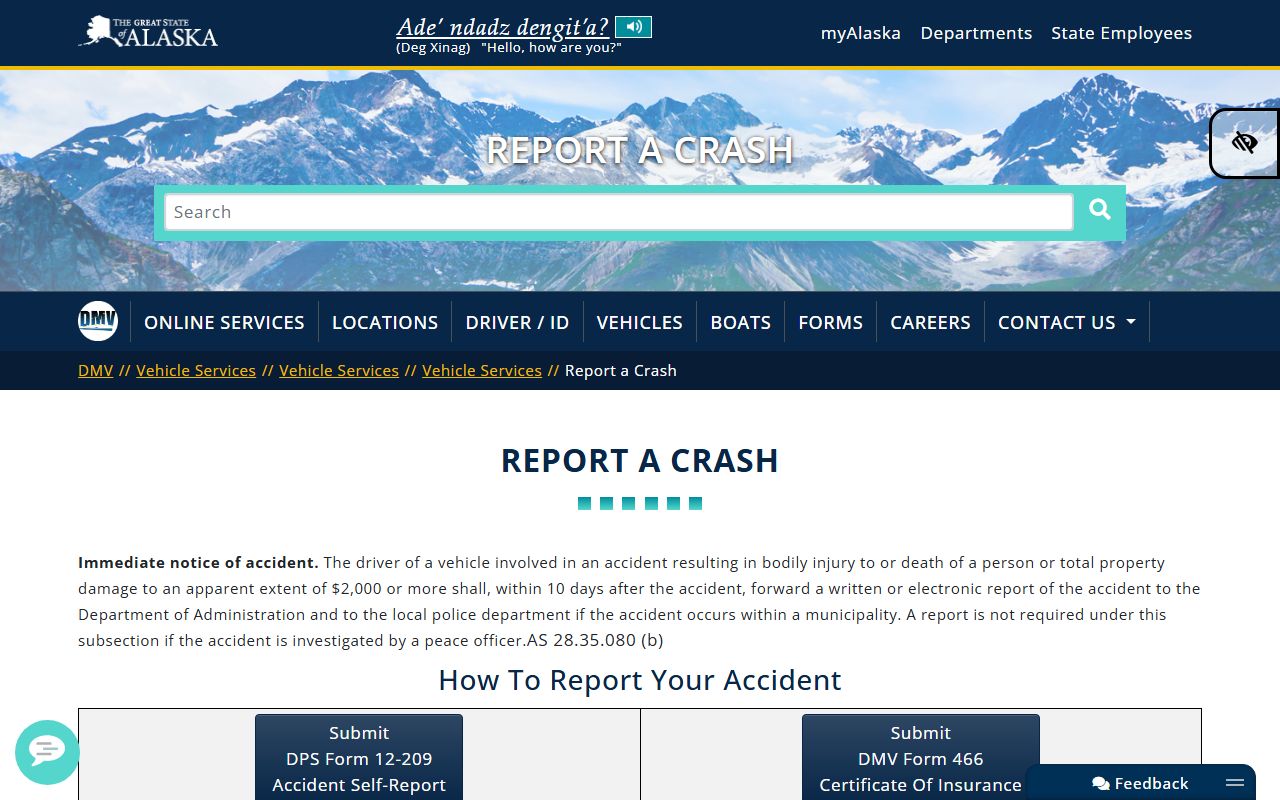
The Alaska DMV page at dmv.alaska.gov explains the full crash reporting process, including which form to use, how to request an existing report, and the 10-day deadline for self-reporting accidents that meet the threshold.
Browse Alaska Criminal History by Location
Alaska uses boroughs and census areas instead of counties. Criminal history resources vary by location. Select a borough or area below to find local court locations, law enforcement contacts, and records resources.
View All 30 Alaska Boroughs and Areas
Criminal History in Alaska Cities
Major Alaska cities have their own police departments and local records offices. Click a city below to find criminal history resources, police records contacts, and courthouse information for that area.